
Ketchup Marketing’s key takeaways from brightonSEO.
What’s better than a digital marketing conference? A digital marketing conference by the seaside.
With talks from SEO experts at organisations such as Trainline and Car & Classic, as well as fellow marketing agencies, we picked up plenty of pointers on just how to hone your SEO strategy on our recent visit to brightonSEO.
Luckily for you, we believe that sharing is caring. So, enjoy reading through our key takeaways and prepare yourself for the odd ChatGPT reference [of course].
TikTok for search marketing - Rachel Pearson, Tilt
If you’ve recently wondered whether TikTok is the “new Google”, Rachel’s answer is a firm no. As the TikTok algorithm recommends helpful and interesting content, it offers solutions to user queries, which to a degree, is a threat to Google’s market share on key search topics like recipe and holiday inspiration.
As content discovery platforms go, TikTok is the faster solution, taking around 15-30 seconds to resolve the user’s needs rather than a lengthy article.
To maximise your content creation strategy, Rachel offers three simple tips.
- Use your hashtags wisely by limiting yourself to three targeted hashtags per video
- Captions and subtitles are essential for TikTok to understand your content, so be sure to optimise them as you would your meta content
- Make the most of the “others searched for” feature to conduct market research and find content inspiration for your brand.
Is content the king in modern SEO? - Carlos Meza, Crowd Content
There’s a big shift towards human-focused content in the copywriting world. But in SEO, the human element is central to success.
To engage with audiences, Carlos advises to keep your content relatable and harness the power of storytelling [copywriters, rejoice].
He provides the H2E3 framework for creating great content.
- Human
- Human-centric
- Engaging
- Empathetic
- Easy to consume.
Carlos’s talk prompted us to ask ourselves “What will your audience thank you for after consuming this piece of content?”.
SEO-first organisation - Helen Pollitt, Car & Classic
Helen provided some helpful answers to the question “How do I create an SEO-first organisation?”.
- Motivate from the team leaders down by talking about your organisation’s processes, how they’re working and the benefits for others
- Improve your templates for briefing copywriters, so that their work is better aligned with SEO best practice
- Make recommendations for areas of improvement and write them up, so that you stay consistent in the advice you give and have SEO-approved guidance to refer back to
- Pair an SEO with someone interested in SEO as part of a mentoring scheme, to build awareness
- Share SEO news and updates that your organisation should know, to keep them up to date with what you want them to know and dismiss the concerns you don’t want them to have.
The value of featured snippets - Niki Mosier, AgentSync
Unfamiliar with the concept of a featured snippet? It’s time to get acquainted.
On search engines such as Google, feature snippets give users the quickest answers whilst keeping them on the search page.
Niki revealed that 19% of all SERPs have featured snippets, and 50% of the average mobile screen is covered with a featured snippet. So, whilst answering a query on the search page might mean you get fewer clicks, a featured snippet generates brand awareness through visibility.
The majority of searches today are questions, with 70% of featured snippets being “Why?” questions. So, your strategy should reflect this.
- Start with keyword research
- Look at keywords that are already ranking
- Narrow your focus to positions 2-5
- Focus on those keywords with the highest search volume
- Incorporate them into features on your website.
Niki also provided some guidance on SEO best practices.
- Target keyword usage
- Relevant links
- Content structure
- Link to the author’s page
- FAQ schema.
Owning TikTok, Pinterest & YouTube SERPs - Carrie Rose, Rise at Seven
Carrie echoed a similar precedent to other talks; that Google is pushing organic content by genuine creators higher up the rankings. Therefore, content strategies must get more creative and utilise creators’ stories.
Whilst most SEOs are chasing Google, Google is chasing its users, so your content should always cater to the user’s search intent.
To achieve SERP success, we need to become more visible. Carrie advises:
- Focusing on demand and attention in all parts of the SERP
- Centering your marketing strategy on people recommending your products or services.
When it comes to achieving visibility, top stories are second to none. Links from these high-traffic pages are powerful, so your content should demonstrate the speed and freshness related to trending stories.
Carrie covered a lot of user-generated content. She revealed that 40% of Gen Z prefer to find information on TikTok when looking for experiences, but they don’t want to be advertised to. Instead, they value the authenticity of content creators.
Using Python with ChatGPT to help automate content creation - Andy Timmins, Online Marketing Surgery Ltd
There was plenty of buzz about ChatGPT, but Andy believes that it can’t replace humans as our input is needed to vet the content it creates to ensure the context and subject matter are correct.
Andy’s advice for using OpenAI to access ChatGPT is:
- Constructing a completion using a model, role or temperature
- Sending the request
- Handling the response.
This code can also be used to:
- Change the input on Slack and Trello
- Change the output on content management systems
- Add additional services such as Zapier, Google and Microsoft.
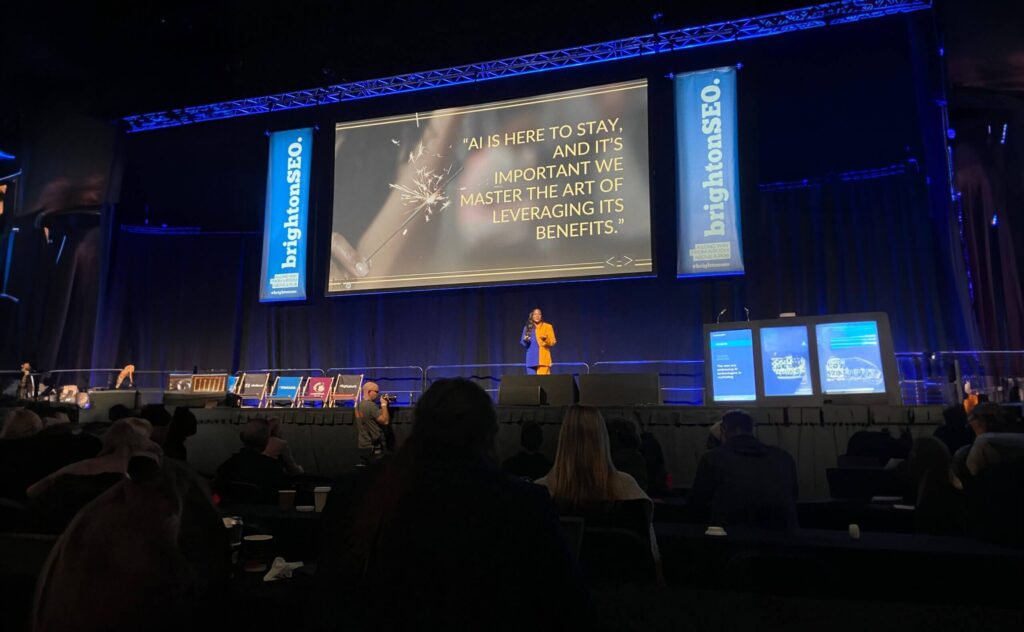
How content design impacts SEO and accessibility - Chloe Smith, Blue Array SEO
Content design doesn’t mean creating copy, instead, it’s about matching the user intent and delivering information in the best possible format. This format should be one that the user expects to encounter based on search intent, and be clear, accessible and offer easy-to-understand information.
Chloe presented the concept of the ‘F pattern’, which refers to the approach users typically take in reading long-form content. This also applies to search results and is most common when encountering text-heavy sites. This pattern represents the approach users take when reading through a text, starting with the headline and opening copy, then skimming down to the next heading.
Chloe advises avoiding…
- Walls of text
- Skipping subheadings, as these are visual anchors for your readers
- Lengthy, time-consuming content.
… And incorporating:
- Short, simple sentences
- Write for an average reading age of 9-12 years
- Section your content for SEO optimisation
- Add jump links earlier on in your content.
Why empathy should be a key player in your marketing strategy - Dr Kiran Webster, Reflect Digital
Whilst traditional marketing starts from the perspective of the brand, empathetic marketing starts from the customers. This customer-centric approach states that you can’t rely on data alone to understand your audience, as this limits them simply to what they do or don't buy. As humans, we’re highly subjective and irrational, which is reflected in the data we produce – but we don’t always understand how.
Dr Webster’s talk really highlighted the importance of crafting a meaningful narrative. Empathy allows us to break through the metrics and see the humans behind the data. Dr Webster recommends that marketing strategy should appeal to system 1 thinking, which is driven by our gut and emotions. This is the default most of the time, with less conscious thought. We feel first, so marketing needs to go beyond rational, logic-based messaging to stop pushing users and start empathising. To achieve this, Dr Webster advises creating personas by:
- Building on existing data to better understand your audience’s motivations and problems
- Utilise social listening, interview customers and develop customer-facing teams
- Work your way down the funnel, starting with the top of the organisation.
Creating a futureproof content strategy with topic clusters - Dirk Schembri, SEO Consultant
Topical clusters are a big talking point in the copy world. These groups of highly-related keywords improve site architecture and user experience, by linking content across pillar and sub-pages to give users the content they’re actually looking for.
Dirk gave some great pointers for optimising your topic clusters strategy.
- With your publishing timeline, have a consistent pace for publishing pages
- When generating your main backlinks, select 1-2 pillar pages and link effectively to them
- Understand your buyer personas to guide them effectively through the funnel
- Be topical, without going too narrow or broad
- Avoid time-sensitive and non-data-driven content in your clusters.
What’s clear from our learnings at brightonSEO is that users want to experience higher quality in less time. Hence, an airtight content and SEO-driven strategy is as important as ever.
If you don’t want to leave your SEO success to chance, we’ve got a bright and brilliant team of SEO specialists who’d love to hear all about your business.