
Why does content that fulfils the Google E-E-A-T principle rank higher?
What is Google’s E-E-A-T principle?
E-E-A-T stands for experience, expertise, authoritativeness and trustworthiness. Google uses this principle to measure the credibility of a web page, its author and the overall website.
Besides recognising your site’s legitimacy and giving you a healthy dose of ranking power, it's also helpful to be associated with these three values to establish your brand within your industry.
Are you wondering what the relationship is between Google’s E-E-A-T and your SEO and want to know how this is impacting your web page's search ranking? [You’ve come to the right place].
Read on to discover everything you need to know and for our handy Google E-E-A-T checklist.
Is Google’s E-E-A-T principle a ranking factor?
E-E-A-T is used by Google’s search quality raters to determine how well the search results meet users’ needs based on the Search Quality Rater Guidelines (SQRG). E-E-A-T is one factor that influences the page quality rating in the SQRG rather than determining it entirely.
Whilst the feedback from Google’s search quality raters doesn’t directly impact rankings, it does inform Google’s algorithm and reflect your SEO, thereby affecting your content’s ranking.
How does E-E-A-T assess your content?
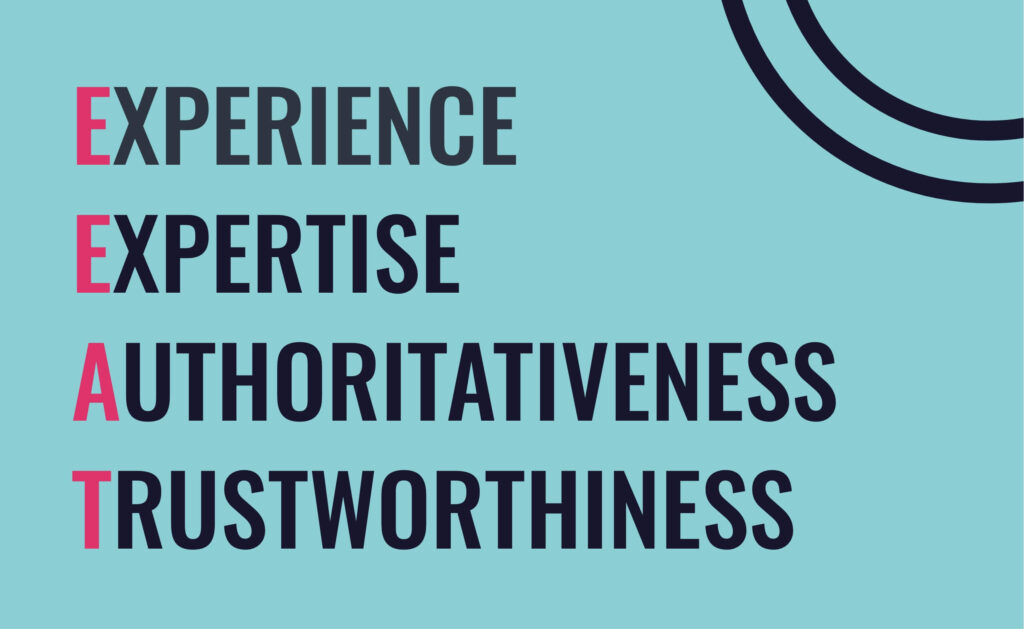
Experience
Your content must offer some degree of experience in the subject matter, whether that’s demonstrating that you’ve visited the holiday location or used the new software you’re writing about. Having quality, first-hand experience in the subject matter means that you can offer a unique perspective to the reader, reinforcing the quality of your content’s narrative.
Expertise
To assess the expertise of your web page, search quality raters review the author to determine whether they are an expert on the topic with the qualifications to back up their knowledge. Alongside this, they also evaluate whether the author may have ‘everyday expertise’, making them well-versed in the topic despite not having expert credentials. With ‘everyday expertise’, think along the lines of a travel blogger sharing their recommendations for top attractions, or a food blogger sharing their favourite soup recipes.
Authoritativeness
Search quality raters measure the authoritativeness of a page by reviewing the main content, its author and the website itself to determine the overall reputation of the creator in their industry.
If you have other authorities in your industry linking to your content, this will demonstrate its [impressive] value and increase its authoritativeness rating.
Trustworthiness
The content, the author and the website are all also reviewed for trustworthiness. [It goes without saying] All content should be written by a trustworthy source and factual accuracy should be a priority, so be picky with who you’re citing. It’s important to also ensure other measures of trustworthiness such as website security are in place.
How can you improve your E-E-A-T rating and SEO?

Here’s our [handy] Google E-E-A-T checklist…
Improve your on-site SEO
Some of the factors you need to consider are:
- Internal links - send your readers to other valuable content on your website to increase their visiting time
- Image optimisation - include high-quality images and alt-text to make your website discoverable through your images
- Title tag and meta tag optimisation - ensure your page titles and meta descriptions include keywords
- Mobile responsiveness - check your website is responsive and as high-quality an experience for mobile users as it is on desktop.
Use credible sources
Ensuring that any sources you cite are reliable should be a priority. Where possible, you should be linking to official sources and the original research or studies to ensure the information you’re using is as accurate as possible. Using trusted sources such as news publications provides factual accuracy and reinforces your trustworthiness [with both your audience and Google].
Be transparent
Google’s search quality raters want to know who is writing your content and whether they’re legitimate sources with the expertise to back up their knowledge. One way to aid this is by creating a team page to introduce each member of your team, their role and their area of expertise. This will help to establish transparency and, in turn, improve your E-E-A-T score [so get smiling for the camera].
Create high-quality content
It was one of our 2023 marketing predictions for a reason… High-quality content not only strengthens your overall brand value for your audience but also reinforces your expertise and trustworthiness with Google’s search quality raters.
By ensuring that your content is original, solves the users' needs and is human-focused, you’re offering valuable assets that search engines like Google will recognise.
With high-quality content only gaining more value, it might be time to perform a content audit to review whether your current pages are up to scratch.
Create authoritative backlinks
Backlinks are a crucial part of any SEO strategy. Earning backlinks from trustworthy sites demonstrates the value of your content and that you are a source of reliable knowledge within your industry.
Increasing the number of high-quality backlinks you have won’t just boost your SEO and work in your favour for search rankings, but it’ll also show your expertise, authoritativeness and trustworthiness in one. [Hat-trick!]
Learn more about the positive impact backlinks can have on your domain authority and search ranking here.
We’ve shared our top tips on how to leverage Google’s E-E-A-T principle to your advantage, now it’s your turn to set them in motion. Dive deeper into your SEO strategy and discover the different types of SEO content you can utilise.