
Marketing relevance: What it is and why it’s vital to succeed.
That’s why some of the most famous 80s pop stars disappeared at the turn of the decade: their hair spray-fuelled videos and heavily synth-based hits no longer spoke to an audience who had just fallen head-over-heels in love with grunge and Britpop.
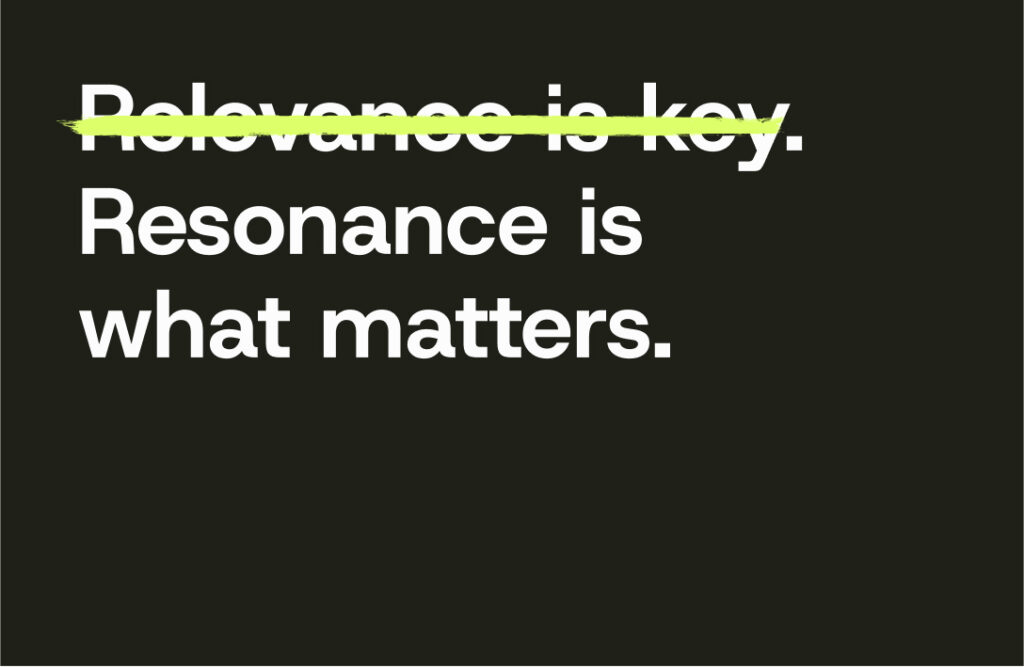
Relevance is key to successful marketing.
For your business to be successful, a cool message or a mind-blowingly creative campaign are no longer enough: you must craft one that speaks directly to a specific audience.
Let’s start with an overview of marketing relevance and learn how to implement it across every aspect of your digital marketing mix. Doing this well will create a valuable connection with your target audience that will help you generate more sales.
Understanding the importance of marketing relevance.
Ok, so: what does relevance in your marketing mean? It’s simply a concept that refers to how relevant your offer (as in products or services), campaign or brand is to the needs and desires of your potential customers.
On our more-competitive-than-ever high streets and, most importantly, in our dynamic digital age, people are constantly exposed to new brands, but will only interact with a small percentage of those that have been throwing ads at them.
Which ones do they interact with?
Simple: The ones that feel relevant to them.
There’s no point in trying to please everyone: you’re not pizza. No matter how good your offer is, trying to appeal to everyone doesn’t work, and you’ll only waste time and money.
An upper-class couple with plenty of disposable income won’t be interested in your student-friendly holiday packages on a budget. At the same time, it’s highly unlikely that a student in their overdraft will care about your luxury golf cruise.
That’s why it’s much more cost-effective to focus your advertising efforts towards a selected audience and ensure that your marketing message feels relevant to them.
We’re living in times of professional phone scrollers with goldfish-like attention spans: you either catch their attention immediately or their thumbs will flick your ad out of the screen without mercy.
Is your business relevant to your target audience?
To achieve advertising relevance, you must really know your target market.
Thanks to the variety of online data we can now gather plenty of information about our main customers. From their characteristics to their needs, we can map their behaviour and journey and how to reach them.
Who are they? How old are they? What lifestyle do they lead? Most importantly, what problems do they encounter that your products or services could solve? Where do they hang out and what keywords are they actually Googling?
At Ketchup, we refer to this as knowing your ‘Janets and Johns’; your accurate buyer personas.
Knowing them allows you to create offers and campaigns that speak to them specifically rather than just sending something out to the masses and hoping for the best.
What is your marketing message?
An effective marketing message (aka one that has the power to stop your potential customers’ scrolling) is one that blesses your target audience with an instant epiphany with its relevance to their life.
If your ads or online content don’t spark an ‘OMG, they’re talking about me’ moment, you’ve lost them.
For example, if you discovered that your target audience loves fashion but feels bad about its environmental and humanitarian cost, you can hook them in by showing them your guilt-free range of sustainable clothing.
Once you know all about your Janets and Johns, as well as what they value the most and what they need right now, you can create a message that resonates and feels relevant to them.
It no longer matters if Stacy and Steve don’t care about you because your offer was never intended for them.
That’s not being passive aggressive; it’s understanding marketing relevance in order to sell to all the Janets and Johns out there.
Where is your target audience?
Relevance must also be considered in relation to your target audience’s location, i.e. where do they physically live or work?
While it can sometimes matter less if you offer online services or digital products, it’s essential if you’ve got a physical location or can only deliver to certain areas.
For example, if you’re a taco restaurant in Manchester, there’s no point in wasting money advertising to people who love Mexican food but live in London: you’ll want to target those in the Greater Manchester area, and perhaps a bit beyond that.
However, when advertising your delivery service rather than the dine-in experience, the location of your target audience will be slightly different: Deliveroo won’t send their riders all the way to Warrington, right? So, your ad wouldn’t be relevant to those who live there.
Actually, it could even upset them, because they might want to try it, but then they’ll find out that they won’t be able to. #SadLife.
Time relevance in marketing: are you sharing your message at the right time?
You’ve identified your target audience. You’ve got a message that speaks to Janet and John directly. You know where they are. Fantastic! To be completely relevant, you must also figure out the best time to show them your campaign.
We regret to tell you that there isn’t a universal answer: it all depends on your message and target audience.
However, that’s something that you can easily figure out by looking at their habits, for example, at what time are they most active on the social media channel you’re advertising on?
Is your offer time-bound? Is it perhaps something that they’re more likely to treat themselves to during the weekend? Is it something that they need to buy now in order to be ready for their summer holiday?
Don’t forget that, for your campaign to turn into sales, your target audience will probably need to hear about it more than once. Three times seems to be the most effective frequency in marketing reach, so allow yourself enough time for retargeting when you plan your campaign.
How are you telling them?
The same message and campaign will have a completely different effect depending on what medium you use to convey it.
While it’s often good to mix and match different channels to retarget your potential customers without sounding redundant, you can’t just pick them randomly: they must either be traditional marketing that your target audience prefers or actively engages with (e.g. a magazine) or online platforms where you know for sure that they’ll be lurking around.
If your product is perfect for people in their 50s, why would you waste time advertising it on TikTok, where the most common age-range is 16-24? In that case, your audience’s digital location will probably be Facebook.
If, on the other hand, you’re targeting people in their 70s, then a good old leaflet through the door would work better than a digital ad.
Market relevance, done right: make sure your brand feels relevant to your target audience.
Now that you’ve learnt all about marketing relevance across different aspects of your marketing mix, you’ve almost set yourself up for success.
Almost.
We’re just going to tell you one more secret, and we hope it won’t break your heart. Deep breath. Ready? Ok.
People don’t really care about you and your brand: they care about what you can do for them!
We know it sounds harsh, but… can you blame them?
We live in fast and dynamic times: nobody’s got time to learn the stories behind hundreds of companies and brands.
That’s why the secret to effective relevance is to make your campaigns, brand and website all about your target audience. Not yourself.
Focus on your audience.
Basically, you should focus on ads, blog posts and content that immediately shows Janet and John that it was created for them and them only.
You must show them how your product or service can solve the problem that’s been nagging them for a few months, and that your content brings them actual value.
You must prove to them that your company’s ethos resonate with theirs, and that the mission that you’ve decided to pursue with your business is connected to what feels important to them.
And you definitely know about it. Not because you’ve been spying on them in person (gosh, we hope not, at least), but because you’ve been researching them, you’ve looked at what they’re Googling and at what problems they’re trying to find solutions to.
Do you sell sustainable coffee that minimises its supply chain and cuts down carbon emissions? Steve who’s always in a hurry and drinks his coffee from disposable plastic capsules won’t care, but Janet who always carries a reusable mug and has been refusing straws before it was cool… well, she will LOVE you for it!
Implementing this strategy and mindset-change will allow you to convey a sense of relevance that goes beyond a single campaign: you’ll create a connection between your target audience and your brand. You, Janet and John are now in this together!
That’s how powerful marketing relevance done right can be.
Do you need help finding a way to sound relevant to your particular audience? That’s what we’re here for!