
Sales lead generation: A comprehensive guide.
Sales lead generation is one of the most common issues our clients face...
“85% of B2B marketers say lead generation is their most important content marketing goal.”
Content Marketing Institute 2016
We often find people scratching their head knowing they’ve got an awesome product, a fantastic team, and enthusiasm. So, how to approach sales lead generation?
Don’t worry. Ketchup has got you covered. We know the right questions to ask and the right techniques to employ for small business sales lead generation. In short, we’re pretty darn talented at getting our clients’ products in front of the right people, at the right time, and in the most cost-effective way. We’re also committed to this cause and have more details on our website specifically relating to sales management, sales consultancy and sales training, coaching and mentoring.
The close relationship between sales lead generation and marketing strategy
It’s impossible to create sales lead generation without carefully considering your marketing strategy. When we work with clients here at Ketchup, we work hard to identify the primary and secondary target markets. Then, we plan the best ways to reach them through our marketing campaigns.
After all, it’s no use aiming your marketing at people who aren’t interested in your product or service. You need to make sure you’re targeting the right demographic who are interested in what you have to offer. That’s at the very root of small business lead generation.
In this post, we’re going to let you in on a few of our own secrets to sales lead generation success and explain how your business can use them in your marketing efforts.
What is sales lead generation?
It’s heartening to think that all of our customers will be able to find us easily as and when they need our services or products, but this is rarely enough to sustain a business. Most businesses have to work hard for leads and harder still to convert leads into customers.
In our industry, for example, it's not unusual to be pitching against another three or four marketing agencies; so, we understand the importance of creating leads that are likely to convert.
Sales lead generation is the process of finding potential customers. What’s more, it’s about finding leads in the right way and then getting the right results. After all, we wouldn’t get very far sneaking business cards into the handbag of the lady in front of us at the supermarket or bursting into a private business meeting with promos.
We’ve got to use thoughtful marketing strategy.
Sales lead generation - how do I create these?

There are three main types of lead, defined by which stage in the buying process the potential customer has reached. They’re also categorised according to the reasons why they offered their details to your company.
Information Qualified Lead (IQL)
An Information Qualified Lead has heard of your company. They may be someone who has visited your site or liked your Facebook page. However, they’ve not engaged beyond this initial contact.
They’re like the beach-goer who has spotted the ice cream stand but doesn’t want to move from their coveted spot beneath the parasol.
Most people would know this as a cold lead.
Marketing Qualified Lead (MQL)
This type of lead has taken things a step further. They’ve read some primary information about your business and want to know more. They may have given details in order to request a callback or might have downloaded some promotional materials to review. They may have requested an instant quote or spent a lot of time looking at their buying options.
This is the beach-goer who’s made a move. They’ve left the parasol and are trying to figure out whether you sell a Flake 99.
This is more commonly known as a warm lead.
Sales Qualified Lead (SQL)
A Sales Qualified Lead is a hot lead. This person has spent their time learning about your company, products or services and has all the information they need to make a purchasing decision. They’re on the edge of buying and may easily be tipped with a conversation, demo or discount.
This is the beach-goer who has found out you do sell Flake 99s and they’ve even found a pound coin in a sandy pocket. They are craving an ice cream!
This is more commonly known as a hot lead.
Converting leads
We want to convert our leads to hot leads as soon as possible. Some lead generation techniques will allow us to get through all stages in one hit - a cold lead to a hot lead - while others take more commitment over time to go through the stages of being recognised as a brand, providing further information and then closing the sale.
Remember that when we get to hot leads, we then need to treat these as real opportunities to sell and convert them quickly.
Lead generation strategies
There are many strategies you can use for small business lead generation. Here's a list of our favourites:
- Email marketing
- Content marketing
- Event marketing
- Automated web forms
- Customer reviews
- Free trials
- Gated content
- Webinars
- PR campaigns
- Quora
- Calls to action
- Live chat
- Retargeting
- Referrals
Let's explore each in more detail.
Email marketing
You can send emails to anyone whose data you have obtained in a GDPR-compliant way. For example, to past clients or to new contacts you have obtained from an approved agency.
The purpose of email marketing in the context of small business lead generation is to turn cold and warm leads into hot ones.
You can do this by personalising emails to individuals, offering exclusive offers or discounts, or targeting previous customers to buy again.
Alternatively, you can do what many companies do and use a company newsletter as a way to keep people in the loop, whether or not they’ve purchased before. This is something we’ve done for local companies Stamford Stone, Fusion Electrics, and Rocket Print Promotions to help them keep their contacts engaged in the long-term.
Although you can send a one-off email, targeted and structured email marketing campaigns are often most effective. We recommend a three-staged email campaign. In the world of marketing, ‘the magic of three’ is very real.
Remember, to capture your audience’s attention; you should attempt to include a subject line that’s catchy without reading as if it’s spam, add compelling imagery and something juicy to engage the reader.
And, of course, you should always include Calls to Action (CTA) in your content. Calls to action prompt your readers to take further steps to engage. This might be signing up to a newsletter, or visiting a site page, for example. You could also lead them to third-party sites that show your company at its best, such as TripAdvisor or TrustPilot.
Ketchup can help you get the balance just right when it comes to email marketing. We write and design email campaigns and then send and track the results. By using email sending software such as MailChimp, we can provide solid data on how well your emails are doing. Useful stuff when it comes to following up on leads!
Check out our email marketing page for more information.
Content marketing
Content marketing is an increasingly popular form of advertising your business. People who have never heard of your company and know nothing about your products or services may still like your Facebook page, read your Instagram stories, visit your website or subscribe to a newsletter simply because they like the content you’re delivering.
For example, at Ketchup, we like to show our audience our personality. Our team loves to have fun. We regularly run sweepstakes, competitions, and social events for our ‘Ketchup Crew'. Part of our marketing strategy involves using our social platforms to show our audience a behind-the-scenes insight into who we are. Take a look at our Facebook page to see what we get up to!
When considering small business lead generation, content marketing should form a large part of your marketing strategy.
There are lots of different forms of content and lots of audience types. Some are looking to be entertained, while others are looking for information or doing product research. The important thing is to have something worth engaging with. What does your audience want to see?
For example, here at Ketchup, we like to show the personality in our office. Our social media is full of posts of team pictures and photos of our gorgeous dogs! These always gain more traction than posts showcasing our work!
Blog posts, webpage content, videos, live streaming, photographs … Keep your audience hooked with interesting and varied content and make sure you’re publishing regularly.
Over time, these cold leads start to engage further with your brand through your content by liking, sharing, or commenting on your social media or signing up to your newsletter, for example.
Event marketing
Event marketing is one of the best forms of small business lead generation.
What is event marketing?
Event marketing is any type of marketing that takes place outside of your usual business premises, usually in a social setting. Some of these events are hosted with the specific purpose of generating leads but some are hosted for other purposes, with the added benefit of lead generation.
For example:
- Networking
- Exhibitions
- Charity events
- Launch parties
- Seasonal events
- Seminars
- Workshops
- Sponsored events
How does it work?
Event marketing works by putting you face-to-face with your target market. In fact, 95% of people surveyed in the Event Marketing Benchmarks and Trends Report believe that in-person events provide attendees with a valuable opportunity to form connections in an increasingly digital world. (Bizzabo, 2019)
This is one of the most effective ways to go through the cold-hot lead in the shortest amount of time.
For example, someone may be drawn to your stand at an exhibition because it looks interesting. They may then start browsing through some of the promotional literature available. A sales rep or marketeer hosting the stand can then engage them in conversation and answer all their questions about a product or service in real-time.
For example, Ketchup recently helped Stamford Stone shine at the Homebuilding & Renovating Show 2019. We helped design and build their stands and created all marketing materials for the day.
Automated web forms
Automated web forms on your website or social media pages allow you to capture customer data from the original point of interest. For example, many sites that offer ‘instant quotes’ ask for an email address before providing pricing information.
The sales team then has a lead to follow-up on and can call the person directly to capture their business. This is an easy form of small business lead generation.
If you’re not sure how to do this, get in touch with us at Ketchup and we can help. We have our own team of website designers ready to add features to your existing site, or even build a new one.
LinkedIn lead generation
“LinkedIn is 277% more effective for lead generation than other social media networks.”
Hubspot
LinkedIn is an incredible platform for getting in touch with exactly whom you need to speak with. For example, if I wanted to speak to the Marketing Director at Ketchup, all I need to do is type in ‘Ketchup Marketing’ and find the right person. Easy as that!
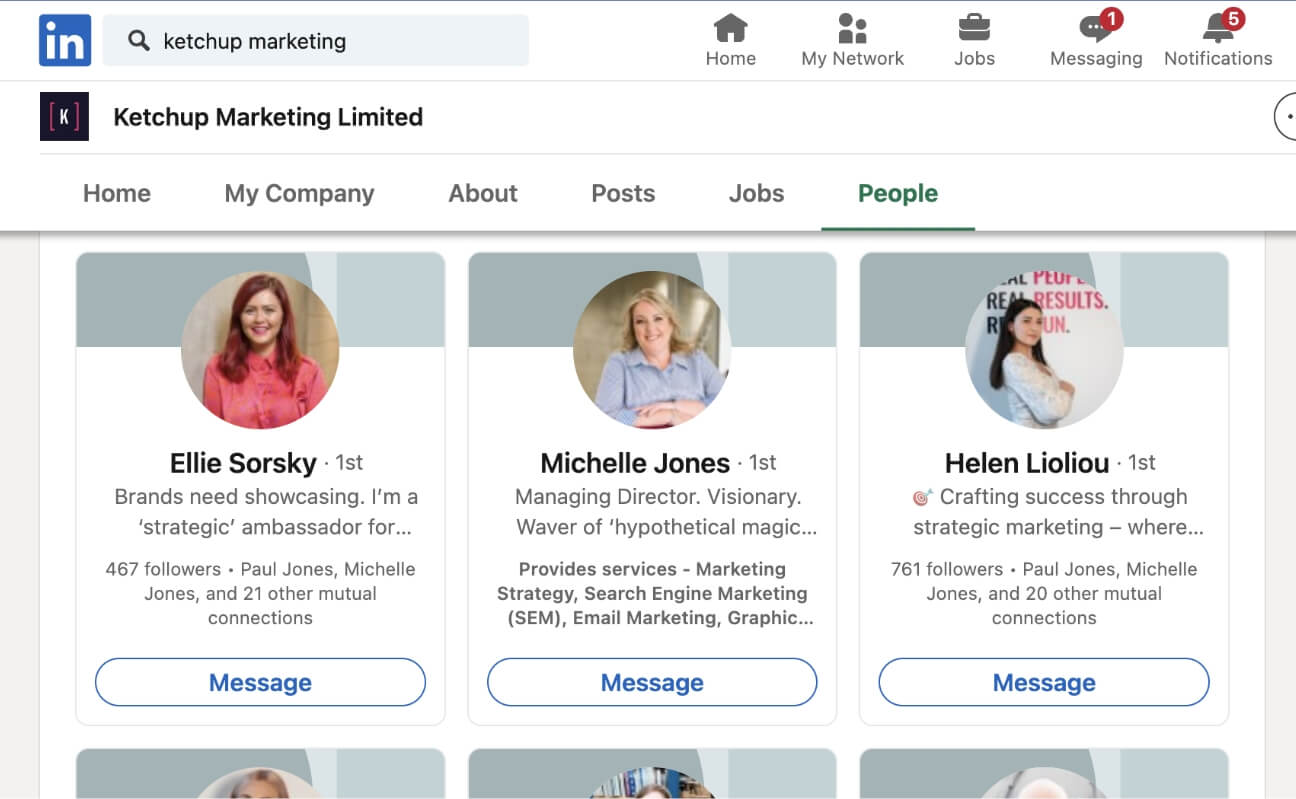
Once you’ve found who you’re looking for, you can message or connect instantly. You know who the person is and their role within their company. This means you can engineer your approach to be entirely personalised and highly targeted. You can go straight to the person with purchasing authority without getting passed around middlemen.
Customer reviews
Third-party feedback generates leads. Think about it – how often do you look at Internet Movie Database (IMDB) before watching a film, or check TripAdvisor before booking a hotel? Would you cook a recipe if all the ratings gave it one star? Third-party feedback creates trust.
When people read reviews, they are 58% more likely to become customers. What’s more, the value of their order is, on average, 3% higher than other buyers! (The Conversation Index, Volume 8, Bazaarvoice).
The lesson here is to make sure that every customer you work with is leaving feedback on one of your channels. This is one of the best things you can do for small business lead generation. Google Business and Facebook are both excellent platforms for this feedback to help your business rise through Google’s rankings.
Alternatively, turn to a third-party for a paid ratings service. TripAdvisor and TrustPilot are popular options. Take a look at one of our clients, Rocket Print Promotions, who make use of one of these services.
But these must be authentic! Build authenticity by always replying to comments. If there’s a problematic review, you should never ignore it. Instead, invite them to take the conversation offline where you can resolve the issue out of the public eye.
Free trials
Everybody loves a freebie! Giving out free trials of services or subscriptions, or free samples of products, allows customers to try before they buy. It also generates hype, as people often share content when there is a promotion or giveaway.
For example, have you ever been through a train station or busy high street where free samples are being given out? Maybe a nightclub has given you a free t-shirt? Or perhaps you’ve picked up a free movie poster at the cinema on a film’s first screening? Freebies are everywhere – because people love them!
The promotion of the free trial advertisement is a form of marketing in itself as it invites a wide audience to engage, but it also gives you the chance to generate hot leads. After all, people who’ve had the chance to sample your goods or services are more likely to buy.
Gated content
Gated content is a hotly-debated topic in the marketing industry. The premise of gated content is that you give valuable content in exchange for contact details. For example, a site visitor might have to fill in a contact form in order to download a white paper or eBook.
This type of small business lead generation is disputed because the marketing industry is moving away from outbound marketing. Instead, consumers are becoming more responsive to inbound marketing —where they come to you.
The argument is that high-quality content generates interest and conversion organically, so there is no need to gate your content. Some consumers will find this annoying and see through the attempt at turning them into a lead. They may be put off by the idea of receiving unwanted marketing emails as a result of giving their details. This may put more people off than draws them in.
This is why many businesses will prefer to provide high-quality content such as white papers and eBooks for free as a form of organic content marketing.
Webinars
A webinar is an online event where a person or group of people with specific expertise host a Q&A or talk online. People can join this webinar and interact with the speaker(s) by posing questions, commenting or participating in surveys.
This is a great way to reach out to a number of people at once. You could use a webinar as an opportunity to explain your product or service to a group of people at the same time, or to showcase your expertise. Either approach will increase your brand recognition and help you explain what you do.
This is a good way to convert IQL leads to MQL leads, or cold leads to warm.
LinkedIn offers fantastic webinars from a huge range of contributors. Other companies create their own webinar series to grow their audience. One example is the Apparel Academy.
PR campaigns
There are endless ways you can promote your brand. The greater the number of people who know about your brand, the higher your conversion rate is likely to be.
PR campaigns can include any number of the following activities:
- Writing as a guest blogger on a relevant site;
- Using social media influencers to promote your brand;
- Issuing a press release about a new product or company initiative;
- Hosting an event;
- Running a contest or competition;
- Going traditional – handing out flyers and brochures to the public;
- Sponsoring an event;
- Running promotional events online and in-store;
- Creating links between your content to increase views.
Answer questions on Quora
Quora is a question and answer site. Simply, people post questions and the community answers.
This is a great way to target people who have questions that your business can provide the answers to.
For example:
‘What’s an easy way to save money?’
This question could pose a great opportunity for a budgeting app to post a link and promote itself.
Or, someone might ask ‘What’s the best marketing agency in Leicestershire?’
And we’d reply ‘Ketchup Marketing. Hands down.’
More generally, if you can answer questions knowledgeably and factually, and do so on a regular basis, you increase your brand recognition within the online community.
Always include a call to action
A call to action is when you give someone the means to take their interest further.
Sometimes, this will be as simple as providing your business contact details. Other times, it can be integrating buttons and links that take people to contact forms, product pages, pricing pages or further information.
Alternatively, it could be us asking you to visit our website right now to learn about our huge range of services, great prices and fantastic team. Or something like that.
You want to make it easy for your customers to buy. Many people lose interest quickly when they’re browsing online, so speeding up the process of converting their interest into a sale.
Live Chat
Live Chat is an instant messenger that is integrated into your site or social media pages so potential customers can get in touch with you online immediately.
This means you can jump on a lead while it’s hot.
Imagine being a customer ready to purchase on a site, but you need a little help choosing between X and Y model.
If the answer is right there, you’re likely to follow through to purchase. If not, you might leave the site. When this happens, this lead can be lost.
Retargeting
Retargeting is going back to previous customers to see if they’d like to repurchase. This works especially well for companies that sell consumables, i.e. items that need to be regularly replaced. But it is also very effective when you offer discounts and offers for repeat customers. Loyalty programmes can capitalise on this further.
My HP printer is great at this. Whenever I install genuine HP cartridges, I get a little congratulations notice pop-up on my screen and a discount code for some other HP service. It definitely encourages me to buy from the original brand, even though it’s more expensive than buying compatibles.
You can retarget through email campaigns, social media or traditional direct mailing.
Referrals
Word-of-mouth remains one of the best ways of attracting organic leads. A job well done is always mentioned, and in the world of digital media, it’s even easier for people to recommend your business.
Some businesses create referral schemes whereby customers are rewarded for directing new customers to your business. For example, a referring customer may receive a discount on future products or on a current subscription for sending a new customer your way.
Let Ketchup take the lead on lead generation
“Lack of resources such as staff, funding, and time remains the biggest obstacle to successful lead generation efforts for 61% of B2B marketers.”
Technology Marketing Community Trends Report, 2015
Within the Ketchup team, we are lucky enough to have exceptional lead generators and lead converters. We love the thrill of the chase and making sure our clients get good value for money in their marketing investments.
We have a team of social media experts, PR specialists, designers, copywriters and marketing strategists at our disposal to help drive new business your way. We can also help you follow up on the leads you have and turn cold leads into hot ones.
We look forward to helping you generate new leads and drive new business!