
Digital marketing: An essential guide for small businesses.
What is digital marketing?
Digital Marketing is the term used to describe any type of marketing that relies on digital technology.
The primary type of digital marketing takes place on the internet, but digital marketing may also refer to marketing on mobile phones and interactive billboards, or any other kind of marketing that uses digital technologies to create interactive content.
Why is digital marketing important for small businesses?
Traditional marketing is losing relevance
Traditional marketing is no longer the primary way of attracting new customers.
More and more frequently, consumers prefer personalised and interactive marketing styles. The modern consumer spends a lot of time daily online — both at work and in their personal lives. This makes the internet the perfect place to engage with your target market.
That’s not to say there is no longer a place for traditional marketing. When considering the marketing strategy for a company, it’s key to take into account the target market and budget, and there are always exceptions to the rule when it comes to which marketing strategy is ‘best’.
At Ketchup, we consider all of the above when we complete our full marketing audit and create our bespoke marketing plan for each of our clients. This may include both traditional and digital platforms, depending on the client’s target market and their budget.
Cost-effectiveness
In comparison to traditional marketing, digital marketing can be highly cost-effective. There are many methods of online marketing that are very low cost or entirely free.
The ROI is also incredibly simple to analyse, so you are able to constantly update and refocus your marketing strategy to get the best results. For instance, social media offers a no-cost platform to engage with your customers with easy analysing tools available.
On the other hand, digital marketing requires a significant time commitment. This is why many companies have entire departments dedicated to this sole pursuit. Others opt to outsource to reputable and results-driven marketing agencies like Ketchup.
Real-time interaction
Digital marketing allows for instant responses in a way that traditional marketing doesn’t. This makes it invaluable.
You are able to respond to your consumers in real-time, whether this is acknowledging customer satisfaction or resolving issues. You can also create updates, promotions, and share news in an instant.
For example, Live Chat services such as Zendesk, LiveChat or Pure Chat allow you to talk to your customers while they are on a webpage. This gives you the opportunity to answer any questions or address any issues that might have stopped them from purchasing if help hadn’t been easily and readily available.
This makes it much easier to keep up with your competitors and to keep your audience engaged.
A global audience
With digital marketing, you are not limited to one audience.
For no greater cost, you can expand your marketing reach as far as you want to go. Whether that’s the UK, Europe, America, or worldwide, you can communicate with other businesses and consumers around the world at the click of a button.
And if this is not relevant to your business or market, or if you’re working to a budget, there are still traditional marketing options available that can be highly effective — especially when managed by Ketchup.
You’re accessible
When you have an online presence, your customers can find you. Sometimes, they weren’t even looking!
When digital marketing is done well, your content travels and brings back interest from all around the web.
You also open yourself up to a two-way relationship with your customers. They can reach out to you as easily as you can reach out to them; often in real-time.
Brand personality
The day of the faceless corporation is gone. In the era of social media and digital marketing, consumers are looking for businesses with personality. Many customers respond to businesses that promote a strong ethos, such as sustainability or fair trade.
Using digital marketing, you break down the barriers between your business and its customers. You’re able to deliver regular, engaging content that can carry any personality. Whimsical, forthright, passionate, technical, modern, alternative, traditional…Digital marketing allows you to easily let your customers know what you stand for.
A targeted marketing approach
Digital marketing makes it easy to categorise, filter, and sort your customers. You can use any criteria to do this: age, location, transaction history, interests, gender.
This means you can create that personalised marketing approach that the modern consumer values and responds to.
If you have a very specific target market, you can narrow down your marketing efforts to those that are likely to have the highest return of ROI in a way that you can’t with print marketing.
Measurable results
The success of traditional marketing methods can be hard to measure. However, with digital marketing, you have access to a whole host of analytical tools to assess the effectiveness of your campaigns. Many of these are completely free and highly effective.
From click-through rates to post engagements, and knowing how many people opened an email, you’re able to tell at which point your customers ‘switched off’ from your promotions, or which approaches really garnered interest.
This helps you to continuously improve your marketing strategy until you find the perfect approach that drives a steady stream of traffic to your site and creates the highest number of conversions.
The internet is the world’s biggest shopping centre
Digital marketing makes it so easy for a reader to become a customer. With one click, somebody on your Facebook page can go to your website. With another click, they’re on your product page. Within minutes, they can purchase.
The convenience of everything in one place can tip the scales for a customer on the fence. It’s just so easy to buy online.
Digital marketing for SMEs and large enterprises
When you market using digital technologies, you level the playing field.
The investment cost of in-store promotions and ‘real-world’ advertising can be enormous.
However, even the smallest company can go viral with a funny tweet or the right brand personality. This is how tiny startups can become huge on a budget.
Types of digital marketing used by SMEs
It’s clear that digital marketing for small businesses is a good idea. It drives business and raises the profile of a brand, all for a low investment. Perfect for SMEs.
But what kind of digital marketing is there?
We’re going to tell you. As experts in marketing, Ketchup knows how it all works. And so should you.
Content marketing
What is content marketing?
Content marketing is based on the principle that making a sales pitch is not the only way to attract customers.
People with an interest in your products or services want to understand them. They want to know what is good value and what isn’t. They want to know what all their options are. They want to know the applications of what they’re buying.
When you use content marketing, you aim to answer questions your customer may have —about your products or services, or about any topic within your industry. The latter is often even more productive than the former.
Good content attracts readers. Readers have the potential to become customers. It’s all about driving traffic to your site so that you are attracting the right audience to your business and raising recognition of your brand.
What makes good content?
Good content is simple, engaging and informative. You want to answer common questions in a way that any ordinary person could understand.
While not creating direct sales as such, strong content builds trust in your brand. It showcases your expertise and creates a connection between you and your audience.
How does it work?
When content is relevant and well-written, it naturally draws customers to your site. What’s more, when you prove your expertise by answering the questions of internet users, you build your perceived authority. This is one of the criteria Google and other search engines use to assess where results appear in their rankings.
So, if you want your website to appear at the top of search results, make sure you’re creating high-quality content that answers questions your customers are asking. (No more writing about your latest product buying trip or product award, Google never shows them to anybody!)
Or ask Ketchup to help. Our team of expert copywriters are professionals in Creative Content, and SEO trained to boot.
SEO – Search Engine Optimisation
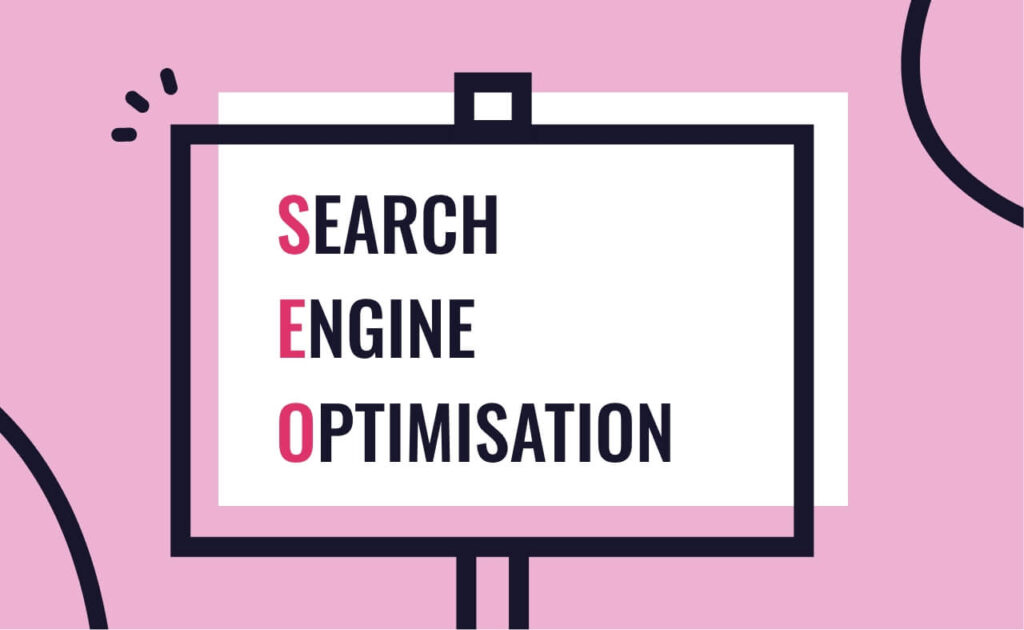
What is SEO?
We’ve all heard the term ‘SEO’, but what does it mean?
‘SEO’ stands for Search Engine Optimisation. This term refers to the practises a website uses to improve its ranking results in online searches.
How does it work?
Unlike some other forms of digital marketing, SEO is completely organic. This means it is unpaid. It’s really a step up from content marketing. SEO supports good content in being recognised by search engines as representing a quality site.
One of the key principles of successful SEO is making use of keywords and keyphrases that are searched most frequently by potential customers.
What are keywords?
For example, if I am a party supplies retailer, my keywords might include the following:
- “Party supplies”
- “Party supplier”
- “Balloons”
- “Streamers”
- “Party hats”
- “Paper plates”
- “Confetti”
To rise through the search results rankings, I’d want my website content to contain these words.
However, it’s not quite that simple. ‘Keyword stuffing’ is the practice of using the keywords many times within a text without proper context. When this happens, Google recognises that the information is actually not very useful and it won’t increase your traffic — it might even harm your online business.
Implementing SEO
There are a lot of SEO improvements anyone can make. For example, including a meta description for every page of your website.
However, a lot of the success of SEO depends on careful keyword analysis. For example, a new party supplies business would struggle to ever reach the first page of search results based on the keyphrase ‘party supplies’. There are just too many businesses doing the same thing, and many of them will be much larger and better established.
However, to rank for the keyphrase ‘party supplies in Lincoln’ might give you better results.
This is why keyword analysis is so vital to get results from your SEO efforts. Luckily, Ketchup has a team of SEO specialists who know how to analyse keywords and create SEO copy. Contact us to find out more.
SEM – Search Engine Marketing
In a nutshell, SEM is paid SEO. It’s the practice of using the pay-per-click method (PPC) to attract customers.
SEM is based on keywords and is like an online auction. In this auction, you make bids for the keywords you think your customers will be using to find products and services like yours.
If you win the bid, it means your site will appear at the top of the search results for those keywords. You will then pay every time someone clicks on that link for the amount you have bid.
Popular keywords can reach very high bidding values, whereas longer or more specific terms can be fairly affordable. It’s important to do your keyword research to make sure you don’t overspend for very little ROI.
Ask Ketchup for help if you’re a keyword novice. We’re experts in SEM.
SMM – Social Media Marketing
Social Media Marketing is a hugely popular type of digital marketing for small businesses. It’s cost-effective, wide-reaching, and very quickly builds your brand recognition among your target market.
What is Social Media Marketing?
Put simply, social media marketing is any marketing strategy that takes place on social media platforms.
Some of the most popular social media sites are:
How to market using social media
The premise of most social media platforms is content sharing. For the most part, social media platforms allow you to share any type of media, including text, pictures, gifs, and videos.
Your aim when using social media as a marketing tool is to share high-quality content to targeted audiences. You are also always representing and building your brand.
Your social media platforms will contain all the details of your business, including a bio of what your business does and contact details. If social media users find your content useful and engaging, they are more likely to click-through to your website and become customers.
DDA – Digital Display Advertising
Digital Display Advertising is when you make use of someone else’s website to promote your own products and services. This is commonly done by placing a ‘digital billboard’, such as a banner or graphic, on their page.
There is usually a low ROI on this form of marketing, but the right content on the right site can do well. The problem facing digital display advertising currently is the rising use of ad-blockers. That is to say, you could pay for an advert that isn’t seen by a percentage of your audience.
Email marketing
Email marketing is another hugely popular form of digital marketing for small businesses. Like social media, it’s cost-effective and wide-reaching.
This type of digital marketing is used to send newsletters, updates and offers to existing customers and to chase leads for new ones. Subscribers may receive regular correspondence, or you may run a specialised and targeted email marketing campaign.
Many companies will use an email marketing platform to conduct their email marketing, such as MailChimp . These platforms allow users to design and schedule emails, as well as monitor the results of their campaign and the engagement levels of their subscribers.
Ketchup can help you find the platform that is right for you, your budget, and your audience.
Of course, your email marketing strategy will be guided by your GDPR requirements. Fortunately, Ketchup are well-versed in how to be compliant with the new GDPR rules.
Ketchup are experts in email marketing. Between our copywriters, marketing strategists, and graphic designers, we guarantee your emails will never be marked as spam.
Blogging and vlogging
Blogging is a form of content marketing. Regular, well-written and informative blog posts on well-chosen topics will keep readers coming back and staying engaged with your website. The more readers, the more conversions are possible.
Vlogging is similar, except instead of using written content, you’re creating video content. Vlogs can be released on YouTube or on your own site. You can also post them on social media.
They are more interactive than blogs, but also more time-consuming and less cost-effective.
Whatever your format, regular, high-quality content from your site will help elevate your brand and keep you rising up the search result rankings.
Influencer marketing
Influencer Marketing is one of the newest and most on-trend forms of digital marketing for small businesses —and it’s fairly tricky to pull off.
This type of marketing is the practice of using an established social media personality as a brand ambassador.
For this to be effective, you need to choose the right influencer with a large enough audience who is popular among your target market. You then need to agree on a strategy and pricing scheme for how they will promote your product or service among their fans.
Affiliate marketing
Like Influencer Marketing, Affiliate Marketing uses others to represent your brand; this time on a commission. That is to say, for every person your affiliate directs to your site, they’ll earn a set fee.
This is a good way to reach an audience larger than your own, and specifically to reach audiences that are relevant to your products and services.
However, there is no saying what the ROI will be until you get going.
Mobile marketing
Mobile Marketing is any type of marketing that is specifically catered towards mobile users. As standard practise, you should ensure your website is mobile-friendly. We also know that many people engage with social media on their phones.
There are also other ways you can engage with customers through their mobiles, such as through the use of company apps with special features and discounts. Many consumers find it useful if they can access products, services, and their own accounts on-the-go.
Ketchup’s expert web designers can help ensure your website is mobile-friendly. Did you know that mobile-friendly sites are ranked higher in search results?
Live chat
Live Chat is a feature many businesses choose to install on their websites to allow them to interact with customers in real-time. This helps increase the quality of your customer service but also gives customers another way to get in touch.
Even if you’re not online at the time the query is posted, Live Chat will store contact details so you can follow up at a later time.
Ketchup – Digital marketing for small businesses made easy
Digital Marketing is not just one process or technique, but a combination of many. To be an effective digital marketer, you need to be familiar with multiple platforms and tools, a competent web analyst and have some knowledge of SEO.
Or you could get in touch with Ketchup and let us manage all your digital marketing as your fully-outsourced marketing department.
For a set fee, you will have the full benefit of our wide range of resources, including the skills of our professional designers, copywriters, SEO specialists, marketing strategists, email marketers, SEM specialists, and branding experts.