Becoming acquainted with Ben.
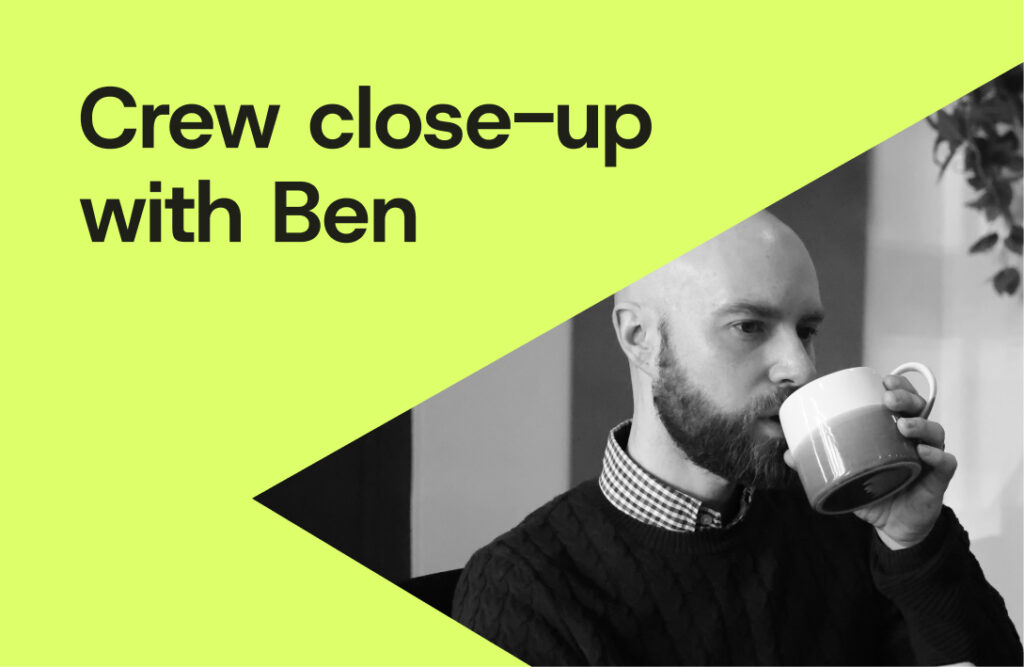
One of our copywriters sat down with Ben to learn all about what makes him the kind of Client Director that gets things done. Ben keeps our pipeline filled with potential, and we wanted to find out what drives him. So we asked about his approach, his most controversial opinions, and what makes Ben, Ben.
Read all about what we found out as we got the questions rolling.
Expertise and approach.
Interviewer: Let’s start by getting to know your expertise, and what your approach would usually be. What do clients usually come to you for when something isn’t working, and what are they actually asking for without realising it?
Ben: Usually, they’re asking for one of the core things we’re pushing: outsourced marketing, or support with their website or SEO. It’s why I’m on the first couple of calls, to try and translate what they think they want, then into what they actually need.
They might say they need a new website, but when you drill into what they actually need, they really need the story they’re telling to be more interesting… and they need a new website.
One recent example: one of our clients came to us for a new website, but what they actually needed was branding and tone of voice work.
Often, what they want turns out to be phase two: branding and telling a story with the website following in phase two, or for SEO calls, analytics being phase one and the SEO following in the second phase. Or we’ll get calls for help with email marketing or social media but what they really need is a marketing strategy in the first phase.
Interviewer: Thanks for that. What’s a mistake you see brands make over and over with their marketing?
Ben: A few I pick up on is companies doing marketing for the sake of pleasing internal stakeholders instead of actually marketing to their clients. Making decisions based on the board not liking the brand strategy, for example. Say the brand is B2C, and the target audience is 25-30 year-old women; the board may not understand the strategy if they’re 55-60 year old white males.
Another is doing something to post on socials because “our CEO is on LinkedIn all the time – we need to post there”. Companies need to keep it about their target market, not pleasing people internally.
Another big one is being scared to be human because it’s deemed as not professional. The fallacy of grouping professionalism with being cold and clinical is outdated in 2026. Not being empathetic, warm, or genuine just makes you come across as non-relatable.
And finally, when companies think they’re unlike any other, totally different compared to their competitors. Talking to us is often helpful because they then learn what is actually a good USP for them to lean on. Positioning themselves as “honest, reliable” etc is a mistake. If you have to say you’re the things every company should really be, it might be time to start again.
It's like Simon Sinek encouraging brands to hone in on the “why” instead of just the what or how in the Golden Circle theory.
Interviewer: We love that theory! Now, for your approach: if you had to describe it in one word, what would it be (and what does that actually look like in practice)?
Ben: Curiosity. It’s never what they think it is. There’s what they say they need, what they think they need, and what they actually need – and each of them is usually a little different. So you have to approach it with curiosity. Once you pick at the surface you realise there’s something over there that we could help you with.
As Tim Minchin says, the most interesting thing is usually the shiny thing in the corner just in your periphery – don’t discount that bit.
Interviewer: That’s a great quote. My next question is where do you think the best ideas really come from when you’re working – structure, chaos, collaboration, or solitude?
Ben: I think the whole thing is a bit of a journey. Collaboration and chaos is like a big mixing pot of taking all the different ideas, based on the steps we need to take. That’s usually 1) what to tell clients we think they need, then 2) getting people involved based on who is needed, then 3) filtering it to get it in order. So I like to start with chaos and collaboration, then in solitude, I distil all the chaos down to something that has a bit more order via a timeline of priorities. Without that, nothing would actually get done!
Without the chaos, you have no bricks to build in the first place, so each of them is important to me.
Ken Robinson defines creativity as ‘genuinely new ideas that have value’. You need an element of chaos, because working within the same parameters would keep it so that nothing would ever be new.
Point of view and taste.
Interviewer: Moving on to trends and point of view: what trends in marketing/sales are you quietly ignoring right now, and why?
Ben: ChatGPT-generated things, like the action figure trend, amongst others. I’m also becoming aware of the environmental impact of using AI for things that are pointless. It creates 16 million miles of extra carbon impact *fix wording*. So any kind of leisure use of AI is a trend I’d avoid.
Interviewer: What’s something you have a strong opinion about in your field that others might disagree with?
Ben: From a sales perspective, I think gone are the days where it’s reasonable to expect a pitch to contain anything near a finished concept before we commit to each other. To an architect you wouldn’t say “build me three houses and I'll choose which one I like”. It’s disrespectful of our time and talent.
It’s important to respect our time and talent enough to tell prospects we’ll create concepts after we’ve agreed to work with them.
Also, I disagree when leads say “I’m happy with the brand – I just need XYZ…” but the brand is almost always not okay as it is. The client is always right in matters of taste, but with everything else, they should be letting us do what we know how to do. You wouldn’t argue with an electrician about the wiring and say you’re going to just rewire that bit yourself.
Interviewer: What excites you most about working with brands today – and what bores you?
Ben: I get genuinely excited when I see something that’s really fun and effective that I know we can help someone with. When they explain their problem and there’s a skill set missing which we could fill, that’s really exciting.
What’s boring is when a prospect treats marketing as an extra “nice-to-have”. When they view it as fundamental to the growth of a business, that’s exciting.
Collaboration and Ketchup perspective.
Interviewer: Now moving into Ketchup-specifics: how does being part of a multidisciplinary team at Ketchup shape your work?
Ben: It makes it way easier to collaborate. If I need to know stuff about copy, design, or SEO, for example, I know exactly who I can ask. Because everyone’s an expert, they know more about their specialism. It’s not a maybe – I know for a fact they’ll be able to help.
It’s also nice to not have to lean on anyone too heavily because there are so many experts in-house.
Interviewer: And what’s something clients might not realise they get access to by working with Ketchup?
Ben: They often don’t realise there’s not really anything we can’t do for them. If they have a problem with their branding, tone of voice, design, website development; even if they have an SEO contract with someone else, we can still help other areas.
Interviewer: What’s the project you’re most proud of that you’ve done with Ketchup?
Ben: I’ve been most involved with the Hubspot automation, so making that all happen was a proud moment. The top, middle, and bottom-of-the-funnel stuff is all specified and automated now, and it works really nicely.
With sales, I’ve made the process smoother for leads to explain their problem and get onboarded by making it a sales process rather than a marketing one. Now that it’s streamlined I think it works well.
Personality and human side.
Interviewer: Now for the personality stuff: what does your brain do when you’re not working? In other words, do you ever stop?
Ben: I make an effort to meditate every day to turn my brain off for 10-15 minutes. Otherwise, it’s like never giving anything a rest. I try to also give my eyes a break from the screens by being outside and maybe gardening – things I’d classify as more ‘real’ activities. It’s a nice balance and it gives my brain a bit of rest in a way that’s productive and revitalising.
Then when I come into the office where I’m faced with a massive ball of chaos I need to put into order, I can face it. When there’s too much on our minds, our brains become less effective at organising it all. So having breaks in nature and time to chill enables me to handle the chaos far better.
Interviewer: What’s a habit or ritual that helps you reset mentally?
Ben: Meditation and any activity that helps me reconnect with nature is important. Our brains are designed to be in nature. Without that, I think it’s easy to forget what’s real. Then, you can start thinking of spreadsheets and invoices as your entire reality. It can be a dangerous place to be, and the truth is that we have no control of the other stuff.
Immersion in nature is that cognitive reset.
Interviewer: That’s so profound though – I love that. My final question for you: if you weren’t doing this, what would you be doing instead?
Ben: I think I’d always do this; I do it because it’s fun. Not to sound like a bumper sticker, but I’m a big believer that it’s about the journey, and not the destination. I love coming in to fix problems and make things better. So I’d just be doing this somewhere else.
Interviewer: Right… but your dream life?
Ben: I’d be involved in more charity stuff. I’d run gardening events for the purpose of boosting people’s wellbeing.
But I wouldn’t be able to resist trying to grow their partnerships and improve what they're doing. I like doing things that leave the world a little better than I found it. I think Ketchup does that.
Ben does have a way with words, and those last words wrapped our interview up with a nice little bow on top. To learn more about Ben or the rest of the Crew, check out our team page!